Showing posts with label Homework. Show all posts

Wednesday, October 22, 2014

A Breif Reflection on 'Democracy in America' by Alexis de Tocqueville

It's interesting how classes from different departments have commonality. Last semester for a class on American Political Thought, de Tocqueville was a required text. When selections of his 1835/1840 work Democracy in America showed up as a reading and reflection assignment for a Media Law and Ethics class this semester, a visceral link was made - so much so that it inspired the undertaking of a massive credit course, an independent study course in the political science department, next semester. Specifically in the area of political communication, mass media, and voter behavior.  A bit social science-ie, but it should be enlightening, and a good way to round out the final semester (still, it's fun to play with the idea of staying on to get a minor in political science, just for shits and giggles). It's self-directed and one-on-one. A new experience to be sure.

It's surprising how many academic topics overlap, politics and (mass) communication particularly.

While in the thick of research and writing, it seemed prudent not to neglect this blog. Despite the expanse of time between entries, you, dear readers, are never far from thought; nor is the therapeutic release that's missing from writing here.

Anyway, the following is a (very) brief reflection on de Tocqueville's text. It got a "Well Done" by the professor, which is an achievement, because she is difficult to get approval from.


Reflection on 'Democracy in America' by Alexis de Tocqueville

In the chapters of Democracy in America provided, de Tocqueville discusses the factors that make America’s political and legal system unique compared to that of its foreign counterparts. At times in these selected chapters he seems to harbor idealistic notions of the potential for America’s new political and judicial system in the early 19th century.
De Toqueville attributes a decentralized government, in which the people, not an elite group or small collective, have more sway over the political and judicial operations of the country and are key to the order of the land. He states that this makes for a “less [...] regulated, less enlightened” (83) society and this broad reach, though boisterous, is perhaps less efficient. De Tocqueville positively credits the Constitution’s relatively rigid power, which is allowed by the people, and the wielding of its power by the judicial system, for granting the courts “immense political power” (92) over American society. 
In reflecting on the various aspects de Tocquevill observed in the American political and judicial environment, what may have seemed a nearly ideal situation in his eyes at the time, would perhaps seem altogether different in the modern age. As the country has grown since his time, decentralization may no longer seem so beneficial, as integral processes of politics and law have become burdensome due to it. The systems involved in effective law and politics have become weighed down in bureaucracy, ineffectual to progress. These issues can be attributed to a problem created by an extensive decentralized government spread out over a vast terrain and impeded by special interests of the very men claimed to have been elected by the people. Additionally, a growing culture of Constitutional reverence has worked to hinder aspects of social advancement.

Sunday, September 7, 2014

Closed For The Season

Hopefully once we get caught up we'll have time to dedicate to writing again...but for the meantime extracurricular blog writing is curtailed to mere "soundbites", if anything at all...and here's why.

Fall Semester 2014:
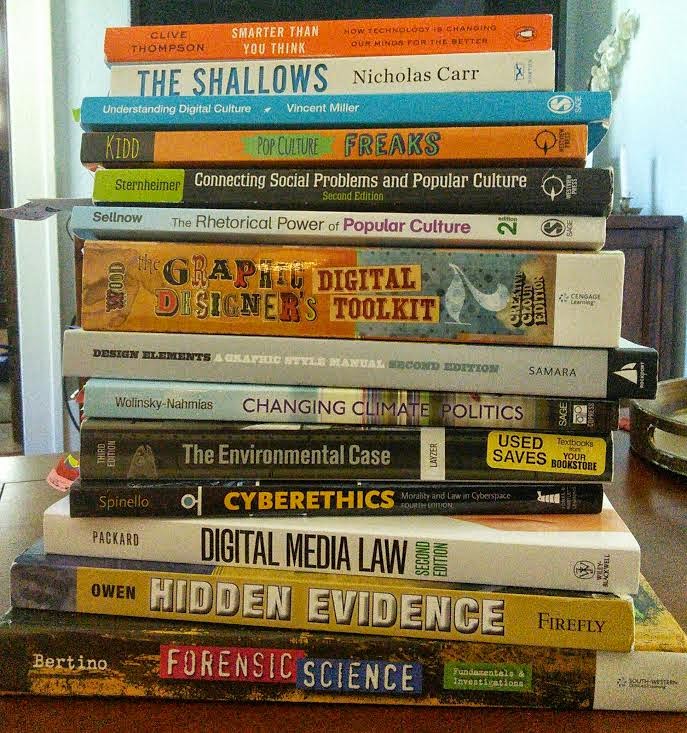
These are the required books for the classes, all of which have to be read and mentally processed into class discussions, assignments and essays, from now to December 10th...


14 books to read...
PLUS...

  • 15 Annotated bibliographies (of outside texts, none of which are these books, meaning we're going to have to read, or at least heavily scan 15 other texts enough to write annotated bibs and use them in an essay)
  • 5 Essays with due dates starting October 28th (4 of which need at least three outside sources that aren't required class texts), plus 1 Midterm essay
  • ...so that's 30 sources (peer-reviews texts and/or books) IN ADDITION to the 14 required texts)..
  • 1 graphic design final exam project
  • Various tests and exams
  • Weekly writing assignments
  • Weekly graphic design assignments
  • Plus contributing found news articles for two separate classes each week.

Plus...we'll still be working (part-time) until at least Halloween, if not Thanksgiving...(they decided to keep the position seasonal after all).
Though the continued income would be nice (not to mention essential), hopefully it's only until Halloween, because it turns out that 18 credits (6 classes) [12 credits/4 classes is considered full time] are overwhelming on their own, never mind cooking and cleaning and essential errands, plus a 40 minute commute twice a day to school/work...

Of course there's always a little time for a bit of Twitter...gals need to relax and have some fun sometimes, yes?

So, we're closed for the season, as it were (shared school-related writing and assignments not withstanding, and a probable final garden report).

Have a beautiful Fall, and may Winter greet you with gentleness. Or may it all rip you apart. It just depends.

Monday, March 3, 2014

About A Dabble At Journalistic Writing

This past week we did something we've never done before.
We performed an interview, and wrote a "feature article".
It was for a media writing class. Of course we write, all sorts of things, and have for over 20 years now. But never this. And never around the context of an interview-based story. Every kind of writing is different. For instance, we are rubbish at writing fiction, but can pen decent poems/prose, and write some wicked essays and opinion pieces, so it was nice to experiment with journalistic writing.

At first we were really scared, not just nervous. Being social is intermittent, and the interview was with a local group of people in the town we moved to just a year ago. It was first contact! Aside from the next door neighbor, two people who work with James, and the chiropractor, anyway. Hey, that's probably, like, half the town actually.

It was an amazing experience, in that it was an exercise in "keeping our mouth shut" when it comes to writing. Turns out it was a lot easier than anticipated. It helped that the interview subjects were very friendly and genuine, and didn't say anything subversive that we would have wanted to pounce on or shove against.

Believe it or not, real journalism requires that the writer/reporter not interject their own bias or opinion into the piece of media they create. When they do, they are no longer a journalist, they are a news commentator (which it seems like most of them are these days anyway, even those under the guise of news journalism), often (usually) paid by one side or the other to give their bias opinion and push their agenda.

In any case, as any regular reader of this blog knows, keeping our opinions out of things isn't really a forte in our writing toolkit...but with this first major assignment, it seems it could be. As the instructor said today "sounds like you opened up a new vein"...which sounds about right for those who are fond of bleeding words.

The grade is still pending, but we have it on good authority that if it doesn't receive an 'A' the "professor has problems". [Special thanks to Charles Bivona #njpoet of http://charlesbivona.com/, for the editing assistance]

Of course, when we suggested to James that maybe being a journalist was a possible career path...he said he'd probably file for divorce.
Incentive?

Friday, January 24, 2014

Friday Nights Are Not For Homework


To be honest, most nights aren't (for homework) around here.
*takes a drink*
Having all of our classes compiled into Monday, Wednesday and Friday, in varying amounts, means all day Tuesday and Thursday are for homework (meaning: reading, reading, reading...and more fucking reading)...and anytime spent on workout equipment that doesn't make our eyes cross at the campus "fitness center". Tocqueville's Democracy in America is too heavy to hold on to [it's over 800 pages!]...aim for the light reading...like the Autobiography of Benjamin Franklin.

What we're saying is...
*takes a drink*
Wait. What were we saying?

Oh, Friday nights aren't for homework.

Also, the internet has been digesting the remains of our soul.

It's actually almost full body consumption.

Some heathen fare, at that. (it's fucking cold, we could do with some Hellfire)

So, put down that homework, and pick up a drink, (no homework? Just drink) and let's take a trip around the internet universe with Frankie, shall we? (If you follow us on G+ or Facebook, some of this may be "old hat") The highlights, anyway.

*takes a drink*

First stop: Reading!

5 Facts Everyone Gets Wrong About Depression
by Mark Hill
http://www.cracked.com/blog/5-facts-everyone-gets-wrong-about-depression/
(If you don't laugh at least once, please have your funny bone checked out by a professional. Also, he's spot-on)

Odd Jobs: Turning Your Ashes Into a Vinyl Record
By Eric Spitznagel
(Press us into some records, scatter the rest)

*takes a drink*

Second Stop: Music!

Birp!
http://www.birp.fm/
Blalock's [no idea who "he" is] Indie Rock Playlist. Yeah, we're those kind of people (eeek, music hipsters!)...sometimes. And actually, we found this website because...uh...we totally have never illegally downloaded thousands of playlists, albums and/or songs using torrent sites. Nope. Never. Except...that once. And it was yearsssss ago. But it got us thinking. Were there more of them?
And then we found the mecca.
You can totally download playlist after playlist of [indie] music via .zip files. No torrents! (unless you want them) Or even stream the playlists and purchase the best ones (from Google Play. What? You buy things from iTunes?! WITCH! WITCH!)
And yes, we actually purchase ones we really like...because...it's the right thing to do. *sigh*
But we also bought this gem recently (among others), and she's apparently singing in the Grammy's this year (which we wouldn't be caught dead watching), but still...IT PROVES WE'RE NOT HIPSTERS (right?!)


*takes a drink*

Last Stop: YOUTUBE!

This week in things that will anger theists...

DarkMatter2525
http://www.youtube.com/user/DarkMatter2525?feature=watch

You love cartoons. And making fun of things, while being enlightened. No? Well, then what the hell are you doing on the internet.
Just kidding. (but seriously...)
Can't remember how we stumbled upon this YouTube channel, but sure glad it happened...because it led to others...

(Click Play, You Know You Want To)


...others like...
The Bible Reloaded!
http://www.youtube.com/user/TheBibleReloaded
Which makes up for lack of cartoonage with hilariously chosen pictures while they commence with their very entertaining "Bible studies".


So, the point is, Friday night is not for homework...it's for letting the internet consume the remains of your soul while you laugh hysterically, or wish you could exist inside of a record now, OR...become a music hipster [the true sign of no soul...]. Or maybe continue being balls deep into that social media stuff (yay, balls!)
It's also, sometimes, for writing completely random blog posts to feel relevant, and promote awesome things.

To Friday!

*takes a drink*


Monday, October 28, 2013

Social Media Literacy: A Speech Transcript

This is a transcript from a speech we did about two weeks ago for a Public Speaking course (holy crap it'll be nice to get done with that class). We were initially going to audio record it for you, but you know what? We can't be fucking bothered to do it...it's amazing we can even continue trudging through the reading, writing and studying...we're starting to lose focus, partially due to mental interruption and stress.

Anyway. The topic, Social Media Literacy and Responsibility, should be important to you. We chose it because it's important to us and thought it would be important to the other students in the class. (We've written on similar topics here in the past: What Happens On Twitter Doesn't Stay On Twitter)

This is a bit more "technical", as it's an informational speech...and since it's for a university class, it is written, and was presented, in the "I" and not the "we". It was also limited to no more than 5 minutes (a second over resulted in losing all timing points).

*sigh*

Without further adieu...
"Imagine you have a really great job, the work is fulfilling, your coworkers and you are good friends, and then one day you are called into a meeting with the board of directors of your organization. In this meeting your “anonymous” Twitter account is mentioned as a concern, and some of your Tweets are referenced. Despite the public not knowing who you are, they have found out and they don’t like the things you have to say. And they fire you.

This happened to me.

Social media literacy skills, that is, the ability to communicate appropriately and responsibly, while approaching interactions critically, and understanding the consequences, while online, is an important 21st Century skill.

According to a report by Pew Institute, 93% of teens and 72% of adults use social media, yet few schools and businesses teach social media literacy and responsibility skills even today; meanwhile participation in social media can have immediate and long lasting impact on a person’s life, from education to employment and even relationships, all simply based on who you allow in your network or the way you express yourself. 
The Library of Congress has now archived, and continues to do so, every Tweet from as far back as 2006. From the words you use to express yourself, to the pictures you use in social media, they can have immediate and long-term consequences. And it’s not just what you write, or who you are, that can cause problems.

Who you allow in your networking circles can effect your life. For example, in the case of Flordia vs George Zimmerman, prosecution questioned a witness on her connections with Zimmerman’s brother on Twitter and Facebook for a full eight minutes.

Your social media connections can also impact you financially in the future.

As reported by Mother Jones, The Economist and Investor Place, there are currently three minor loan companies that use the credit and spending habits of Facebook connections of those seeking loans, to determine the risk factor of loaning money. According to reports, this may be a trend for larger loan companies in the future.

When people look at social media they often see it as a platform of free speech and self-expression, but rarely, do they consider the consequences.

For example, Johnny Cook, a Georgia bus driver, learned that one of his middle-school passengers got denied school lunch because his account was .40 cents overdrawn. Upset, he vented on Facebook about the unfairness of the situation. It was a reasonable rant, but his employers discovered it and he was fired. According to Business Insider, in 2011 there were 17 similar cases.

Again, in the case of Florida vs George Zimmerman, witness Selene Bahadoor was confronted by the Defense for a Facebook petition she “liked” that “championed” the arrest of Zimmermann.

Both of these unfortunate events are results of poor social media literacy.

Further what people write can be misinterpreted because there is often little context, no voice inflection or meaningful facial expression in social media communication.

Your actions on social media can even have an effect on future employment. 
According to a report by Reppler, a social media image consultant company, 91% of the 300 sampled hiring managers report using social networking sites to screen potential employees, of that, 69% reported that they rejected an applicant because of what they saw of them on a social networking site. Another survey by Kaplan Test Prep, a college prep organization, stated that 35% of the 500 college admissions offices they surveys admitted that something they saw online about an applicant negatively impacted their application. That’s up nearly 25% in a years time.

The good new is two states have currently passed laws protecting students and employees from having to turn over their log-in and password information to their schools and employers, and there are currently 36 state bills designed to do the same thing waiting to be passed. But they can still monitor your accounts, so the National Labor Relations Board has also passed ruling to protect the first-amendment rights of private sector employees. Of course none of this is a guaranteed protection.

This is not to say that you should be afraid of social media, or censor yourself, but rather recognize the potential permanency of social media/internet interactions, and its ability to have a long lasting impact. As you move through your life learning responsible communication and being aware of the consequences of actions that you may consider innocent, can be very important both to you and people in your life."
--------------------
Sources:
Tillman, K. (2010). Do Media Literacy, Digital Literacy, and Social Media Literacy Intersect? Edelman Digital.
http://www.edelmandigital.com/2010/04/01/do-media-literacy-digital-literacy-and-social-media-literacy-intersect/

Pew Research Center. (2013). 72% of Online Adults are Social Networking Site Users.

Pew Research Center. (2013). Teens and Social Media.

Library of Congress. (2013) Update on the Twitter Archive at the Library of Congress.

Eichelberger, E. (2013, September 18). Your Deadbeat Facebook Friends Could Cost You A Loan. Mother Jones.

Trivedi, A (2013, June 6). Georgia Bus Driver Fired For Facebook Post. Time.

National Conference of State Legislatures. (2013) Employer Access to Social Media Usernames and Passwords

Greenhouse, S. (2013, January 21). Even If Enrages Your Boss, Social Net Speak Is Protected. New York Times. http://www.nytimes.com/2013/01/22/technology/employers-social-media-policies-come-under-regulatory-scrutiny.html?_r=0

Kaplan Test Prep. (2012) Kaplan Test Prep’s 2012 Survey of College Admissions Officers.http://www.kaptest.com/assets/pdfs/Highlights-from-Kaplan-Test-Preps-2012-College-Admissions-Officers-Survey.pdf 

Thursday, October 24, 2013

Rhetorical Moves and Devices In Writing: A University Essay

We finally got our first paper back for College Composition II...and the grade was...adequate. We could have done better...we could have gotten a 96% instead of a 93% (yeah, yeah, you're thinking the grade was great)...but it'll have to do.

The class has been great, in general; we've even written about an experience we had a couple of weeks ago in it. The next essay/paper due is a dozy, and we'll be working on it this weekend. Currently it's a menagerie of scattered information and concepts that need some duct tape and string. It's going to be a great paper...yeah...

Anyway...back to the paper.


The topic was based around literary moves and rhetorical choices in the book Lies My Teacher Told Me: Everything Your American History Textbook Got Wrong James W. Loewen (a great f'ing book, by the way), and explaining how his introduction shapes or sets up the text’s purpose. In addition, explaining how the rhetorical choices (moves, devices, and strategies) Loewen uses forms, informs, and helps shape that purpose.

So...if you're interested in that kind of topic...have a read. (Uhh...it's a seven page [double spaced] paper...so be warned)
The teachers comments are included at the end.

If this isn't your "cup of tea"...there are loads of other things here for you to read.
--------------------------

Loewen’s introduction serves as a general platform for justifying his writing of Lies My Teacher Told Me. Coupled with reoccurring and non-reoccurring use of rhetorical moves and bold devices, he establishes credibility, and adequately prepares the reader to approach each chapter with insight into his character, as well as the context that surrounds his writing. Additionally, he conveys how he feels about history, stating it’s “full of fantastic and important information” (Loewen 3), posing the question “What has gone wrong [with it]?” Backed with supported information in the introduction, he approaches the reader with citation and references establishing credibility in a timely manner, working towards the eventual reveal of controversies and “conflicts” in history. Loewen assigns responsibility for the missing information and misinformation surrounding what we think we know about history, unfolding literary moves that flow throughout the text, illustrating his points and validating the purpose of Lies My Teacher Told Me.
By making bold daring moves straight out of the gate with statements like “Something has gone very wrong” (Loewen 1), Loewen instills a bit of intrigue, setting the path to impart concern while hooking the reader. “What is this? What has gone wrong?!”, we are left asking. He then follows the posed issue with an explanation, supported with evidence conveying authority. Similarly, Loewen uses this literary approach with the phrase “Textbooks stifle meaning by suppressing causation” (7), explaining that by “[leaving] out what we need to know about the American past” (7) students do not grasp the synchronicity of cause and effect. Loewen repeats this move later with the “headline grabber” “The truth is that Helen Keller was a radical socialist” (13). To many American readers the idea that somebody who has been, historically, held up with such esteem could be a radical socialist, is startling. By beginning the paragraph in such a bold “shocking” way, Loewen effectively grabs the attention of his primary audience as he pulls them in with supports to his claim. Again, in chapter three with “The true history of Thanksgiving reveals embarrassing fact” (Leowen 90) he captivates the reader. Using a word like “embarrassing” applied to a holiday that many North Americans hold in such regard, could seem, to some, shocking. In addition to being titillating, using these bold astute assertions convey authority. Rather than using phrases like “I think…” or “In my opinion…” which some readers may find diminishes authority in his tone, he puts power behind what he is trying to say. The key move behind these statements is to draw you in, to illicit an emotion, to capture your attention and to validate Loewen’s voice.
Loewen goes on to make an appeal that history is actually interesting and important, making a compelling case for his claim. Using words like “fantastic”, “important”, and phrases like “power to spellbind audiences” to describe it, Loewen passionately asserts that history is not “boring”, “predicable” or “melodramatic“ (Loewen 3, 5) as the textbooks may lead a student to believe. He moves to provide relevant examples to prove his point by mentioning the enduring popularity of History as a subject in media formats like public television, movies, other books about history, museums, etc. (4-5). In doing this, he illustrates that the public is actually interested in history; and not only is it interesting but you should be interested in it, not just because it is exciting, but because history is important. History is “directly relevant to our present society” (Loewen 3), he says “More than any other topic it is about us. Whether one deems our present society wondrous or awful or both, history reveals how we arrived at this point. Understanding our past is central to our ability to understand ourselves and the world around us. (Loewen 2)” Perhaps Loewen’s strategy of telling the reader that history is interesting and important, is to convince readers that his text can be set apart from those “others” - those textbooks full of dry material - because he understands this; he understands it and is preparing the reader for “his” “amazing stories” (8) about “us”. Using this approach, backed with reasoning, Loewen gets the reader to understand that history is important, interesting even; but it may not be your fault if you think otherwise.
Loewen shifts, first suggesting teachers and students are mutually responsibility in a perception of each other’s low interest in the history. Teachers respond to the low morale of students towards history by “going through the motions”, which makes history seem uninteresting to the student, thus propagating low morale in a vicious cycle (Loewen 2). However, Loewen then spends considerable time assigning layers of responsibility, making the claim that textbooks “alienate students” (6). Then taking aim at textbook authors, and publishers, he establishes blame for the crux of the problem, systematically deflecting it from students. It is the textbooks themselves, formidable in size and content, and physically unbearable to transport (Loewen 4); the textbook publishers are too unconcerned with outdated content to laboriously peruse the books to remove it, and they are “unaffected by recent research” (Loewen 7); and historian textbook authors receive no respect from their peers to be bothered to update them (Loewen 7). These are all very powerful declarations supporting the argument that it is not students’ fault that they may find history uninteresting and unimportant. By reducing primary audience blame, Loewen works to align them with “his side”.
Loewen implores the reader to consider the significance of asking questions about history. In using plural pronouns throughout the text, and continuing to pose queries into who “the we” are in these narratives of history textbooks to begin with (Loewen 64,37) he places us in the narrative. Loewen leaves us questioning who history is being written for; if “it is about us” (8), at the core of who we are, and “central to understanding ourselves” (2), do we not then have ownership in it, he implores; do we not have rights to more than basic facts and cloaked “evidence and reason”. By not having access to source material in textbooks, we are not encouraged to think critically about what we are reading. The “textbooks keep students in the dark about the nature of history by offering them “reasoned judgments” (Loewen 8), leaving out conflict and controversy so we have no chance to the scrutinize history, and therefore have no concrete way to determine who the “we” are or “understand the world around us” (Loewen 2). His message here, effectively communicated, is that we must be offered as much information as we can, so that we can think critically about it and who we are, and textbooks do not provide adequate resources for that. Therefore, if we do not ask questions about our history, and are offered only piecemeal information, we end up being whoever they say we are.
Moving towards punctuation, Loewen’s use of scare quotations throughout his entire text pointedly draws attention to words. It is why Loewen uses quotations to draw attention to the words that is important, such as in “Legacy books”(3), “new new”(3), “war on terrorism”(8), and then in the meat of the text with “ruling class”(28), “establishment”(29), “primitives” (49). Shedding light on these words and phrases that are weaved through the tapestry of history books, he encourages the reader to think about them. What images do these words conjure, how, when used do they effectively elicit a deeper meaning. For example, by using a term such as “primitive” in conjunction with the native tribes of early America the reader is left with nothing but very crude ideas of the (lack of) culture and “savagery” that may have existed. Likewise, the term “savage”, when applied to historical texts brings to mind animal-like primitive people, perhaps even “godless”. His intention in using these quotations become clear, that some words written in history textbooks can frame your way of thinking about the people of history, and it is just another way we are cheated from the whole story.
Loewen continues to use quotations in his introduction to reveal his character and personality. Listing book titles that include inflated words like “Great”, “Triumph”, “Promise” and “Pageant” in their titles and juxtaposing the titles against those of more modest subjects, such as Principles of Chemistry, Loewen wittily pokes fun at how the publishers try to profess the books grand completeness (6), cleverly revealing the sense of ego and clear nationalistic slant many textbooks take. Additionally, Loewen effectively makes use of quotations as a literary device in the introduction in several different ways, in some cases establishing a relationship with the reader, and in others demonstrating his character. For example implying students may say “nothing good will come of this” (Loewen 4), he communicates that he understands, establishing relationship with the reader. By suggesting that textbooks hype themselves with underlying messages such as “You have a proud heritage. Be all that you can be” (Loewen 6), the reader can reason that part of Loewen’s character does not include overly patriotic or nationalistic tones. These specific moves work well illustrating dialogue, and may subtly align the reader with Loewen if they understand he is being both funny, and understanding of the “history textbook plight of the students”.
Finally, Loewen discusses his professional credentials, the hours of work he put into writing the text, revealing his (negative) experience of having been part of a textbook creation, and disclosing how his view through a sociologist eyes may be applied to his view, further legitimize the work at hand (8-9). By waiting until the end of the introduction to “introduce himself”, he keeps it fresh in your mind that he is indeed qualified to make the claims, to pull the punches as you delve into the chapters. This move poised at the end has the effect of ushering the reader into the first chapter of the book with confidence in Loewen’s credibility and ability to inform you what has been missing from your history.

Loewen’s overall tone in the introduction can be interpreted as effective in preparing the reader for the potential bold devices in his book, as well as the parts of his personality that might show through. Establishing basic professional credibility and connectedness through key moves, we can understand his motivation to reveal to us the interesting and important information history has in store for us.
-----------------------------------------------
The notes from the instructor that came along with the grade: 
"You clearly understood the effects of Loewen's choices as a writer and can see the larger issues inherent in these choices. You present a sophisticated analysis of his work and are incredibly thorough. There are moments though, when you begin to lose focus; and, at times it felt like you thought you had to include everything. This semester let's work on focus and choosing the strongest arguments and examples to stand. That said though, this shows real critical engagement with the assignment and Loewen's text. Very well done."


Thank you for making it this far. Wish we had some candy to give you...

Tuesday, October 8, 2013

Photography Alterations (In Magazines): Homework Highlight #4

This critical thinking assignment was about how magazines use Photoshop, and other photo editing tools, to change pictures, and whether or not there is a time when it is appropriate.

These may seem like soft subjects to you, but as a (Mass) Communications major, these types of things are at the foundation of media ethics.

Here we go...

"The altering of photographs is very disturbing; especially with the great lengths they go to these days. It would be much better if the photographers learned how to use light and shadow, and other photography techniques, in lieu of blatant trickery. 
You know, learn to be a professional photographer. 
I find it particularly disgusting that they take already attractive people and turn them into something society holds up as a standard people try to attain; when in fact nobody can look like that, because if they could the photographers and magazines would not need the extensive airbrushing and manipulation techniques they use. 
 
I think, in this society, it’s pretty well known by the majority of adults that all magazine content is airbrushed to some extent. I don’t, however, think that children of a certain age understand it, and when they see those covers while standing in the line at the grocery store at very impressionable ages they are indoctrinated with a warped idea of what they think society believes is beauty. I find it rather tragic.  
 
Sometimes alteration of photos may be appropriate if they are trying to remove something from it that wasn't supposed to be there (maybe a dog “photo-bombed” an otherwise perfect shot.), which seems unlikely in this digital age, because you would know it immediately and re-take the shot. (in the case of professional photo shoots), or if they are trying to make a statement. 
However, if the photos are manipulated too extensively, other than just changing the light of the overall photo, or perhaps removing a blemish, then it should be stated somewhere in the photo credits. 
When altering of photos goes so far as adding things in that aren't there, or removing them, for the purpose of clear deception, I think there is a real problem, and it should be exposed. 
But then, I’m not even a supporter of adding and removing things from photos (like people, for example) and passing them off as legitimate original photos even in the most "innocent: of cases, which now can be done with just a smartphone app."
Not groundbreaking...but you should read the pap the other students write...
Literally two sentence answers saying that they have no opinion.
We're required to read and comment on at least two a week to even get our assignment graded...*jabs self in eye*

So far we have been heralded by students for having interesting content. *pats self on back*...so just because YOU don't think it's interesting...


Saturday, September 21, 2013

Censorship (In Books): Homework Highlight #3

Again from our Communications class, when asked in Discussion and Critical Thinking what "I" think about censorship and what books, if any, would I censor if I was a librarian. (This assignment weeks topic was books.)

The professor of this class requires multimedia in the posts for class. These assignments are submitted through a program called Blackboard, a virtual learning environment and management system used to work in conjunction with classroom lectures. (It's a poorly scripted program, to be honest - but a lot of the Universities use it)

So, this was our critical thinking response on the topic of censorship 
Whether or not any censorship is permissible in any instance is a difficult call.
As a society, should we allow targeted hateful rhetoric.
It doesn’t seem like a moral move to allow something of such negative value. It would be nice to live in a society of mature adults where that wasn’t even an issue; but utopia will never exist. 
Censorship spans every type of mass media format not just written word, and not just hateful implications; if anything one might dare say censorship of targeted hateful rhetorical is least likely to be censored in lieu of revolutionary or controversial ideas that challenge religiously based morals or beliefs. In books, the danger of censorship is ten-fold, because books contain knowledge and information that a sole reader is responsible for understandings and gaining meaning from, which is unlike any other medium in mass media. (i.e. nobody is telling you what it means and you are challenged to figure it out on your own) 
Watch Video


[To Silence a Learner (Censorship Brickfilm PSA)] 
Certainly, there is room within individual homes and lives to allow for personal censorship, but censorship of controversial topics imposed on a society as a whole is abhorrent. 
When it comes to books, like with any other media source, it should be up to the individual to decide what they should or should not read. If they are uncomfortable with the content they can put it down, but they don’t have to be dictators for what other people might be perfectly comfortable reading. Perhaps parents and members of society can use their fear (because that’s what it is) as an opportunity; reading subversive and controversial texts can create a platform for mature discussion, not only between parents and children, but between any groups of people. 
[Censorship And Media Opoly] 
Certainly religious organizations, government, or corporate entities, in a free democratic society, do not have a place in telling people what they can and can’t read; of course that doesn’t stop them from trying. Censorship by any group of people, that further promotes their self-interests, without allowing opportunity to form objective views, is repressive and is a violation of freedom.  
What books are worthy of censorship? Unless it is purely a platform to spread ignorant hatred, based on nothing but the characteristics of another persons being, or in the event they contain misleading or incorrect information, there is no time to take books from my library shelves. Books are a foundation to personal freedom, and to me, the freedom to learn is the doorway to becoming a well-developed human.
Having said that, perhaps it is a little hypocritical to think that the topic of hate is where the line should drawn, so, all the books stay. I just won’t read those (but the ones full of misinformation go).
It's only a 100 level course.
The professor has "praised" us for our level of work and "excellent analysis" - but having nearly 15 years (mostly) on almost the entire class...of course our writing shines.
Even cow shit sticks out in a field of rabbit turds. 

Wednesday, September 18, 2013

Weekly Update

(image source)
This week:
A paper (2nd draft w.i.p.)
One quiz.
Two tests.

Homework.

Work.

We've managed to hop on the elliptical a bit, just to try to cull some mental balance.

...

Word is our contract for work may be extended two weeks to a month, depending. So, by around Thanksgiving we'll have time to write about all the mental breakdowns we've been having, (ugly, ugly, ugly)...the headaches...the problems...

Meanwhile.

All of our creative juices have been limited to 140 characters.
Thank goodness they are being stored in the Library of Congress (and downloaded periodically to our computer via Twitter archives) so we won't have lost any of our poetry that only exists on Twitter.

Now...back to it.

Thursday, September 12, 2013

Media Conglomeration: Homework Highlight #2

Source
It's from our favourite class, this assignment, which is appropriate since it's a communication class.

Last week we posted a response to a critical thinking assignment, this week we'll do the same (there's just not enough time to write anything for the blog these days, except in great times of stress - sorry).

One of the questions from this [past] week was about the thrust of concern when it comes to media conglomeration, and whether or not "I" agree.

"The thrust of the concern about media conglomerations is the systematic removal of democracy by a relatively small (special interest) group of people. Freedom is choice and choice is democracy. The concern, which I agree with, is that if a handful of large organizations own the media, they dictate what we see, what we hear, what we know. They create programming to serve their own agenda; aside from the obvious financial agenda that is the cornerstone of our ever-growing Consumer-based “Free Market” society/government. The risk is the removal of consumer choice to make informed decisions about our world, thereby taking away our individuality and our personhood, which are the wonderful parts of freedom, democracy and a diverse mass communications system."
It may surprise you how short the response was, but it's easily 3x that of most of the students in the class...so...we shall defend it no more.

Saturday, August 31, 2013

At The Risk Of Everything

Source
So, this was our first week of University classes.
Day one found us having panic attacks.
By the end of the week we were better...mostly.

Ten years ago when we attended university for the first time it felt much less...overwhelming...from what I can recall.

In any case, having compiled all of our homework for this semester into a handy little document, we realize...we're fucked.

There's so much of it. With work, and a relationship, housework, and time to decompress (which we need, to stay relatively sane), and the commute...

It's tempting to play with the idea of being on medication again, just to take the edge off.

Last time we attempted this (University) we
a) were not working, other than work-study (which mostly involved studying)
b) were on prescription meds
c) tended towards marijuana, which helped us focus (yes, focus. We were an A student) - and didn't ever touch alcohol.

Now.
It's different.

In any case...we're saving most of the opinions on our experience of our first week for a future blog post...tonight...tonight we're tempting fate.

We have a lot of writing to do for University, some we want to share with people who read this blog...however, the risk is that an instructor does a content search of something we write after it's already been handed in and graded, and lands here...

Needless to say we have had no luck with employers finding this blog and continuing to employ us; so hopefully all will go well.

This week, when asked to write about what optimistic predictions of the internet I think proves inaccurate, and what optimistic predictions may be realized...this was the response:
The prediction that the Internet and World Wide Web would bring people closer together, and create additional ways of accessing information is one of the most optimistic ideas; and the truth is that with optimism comes pessimism.  
The paradox of the WWW is that while it certainly has been bridging gaps between cultures and people around the world, bringing them together in new ways, it has also separated the very people in shared communities. People are increasingly becoming obsessed with their online lives, pushing those physically close to them to the outskirts while they maintain constant contact with others, often near strangers, around the world. In addition, while the idea of bringing people together across cultures sounds overwhelmingly positive, it is often forgotten that it also brings together worlds that can become increasingly dangerous, bridging gaps between domestic and international terrorists, uniting enemies, growing and fostering hate groups. But then, countless friendships and connections have been created over the internet. It is the ying and yang of The Web. 
While the Internet is full of information, without media literacy and responsibility, it is near impossible for the full potential to be realized, used and properly appreciated. 
For example, The Onion, [is] a satirical news website that often times gets taken literally by people who lead with their emotional response and who often have poor media literacy skills, and often the confusion and anger that arises gets further spread through communication channels over the Internet. 
Optimistically, as people learn how to disassemble information they access on the Internet, and to understand the importance of citing legitimate and valuable sources, access to a network of free learning is possible; which is about the best thing that the Internet can provide.
It's not the best writing, but hey, it's been awhile since we've posted anything good to this blog...

Our first week of classes...under the belt. Only fifteen more to go...