Showing posts with label Reviews. Show all posts

Saturday, April 22, 2017

Frankie Goes To Vegas: The Rockabilly Edition

This was the fourth trip to Las Vegas over the past just about 10 years, the second in just two, and marks the first that was for an actual event, and not just Vegas for the sake of Vegas.

The Official Viva Las Vegas Rockabilly Weekend Cruiser
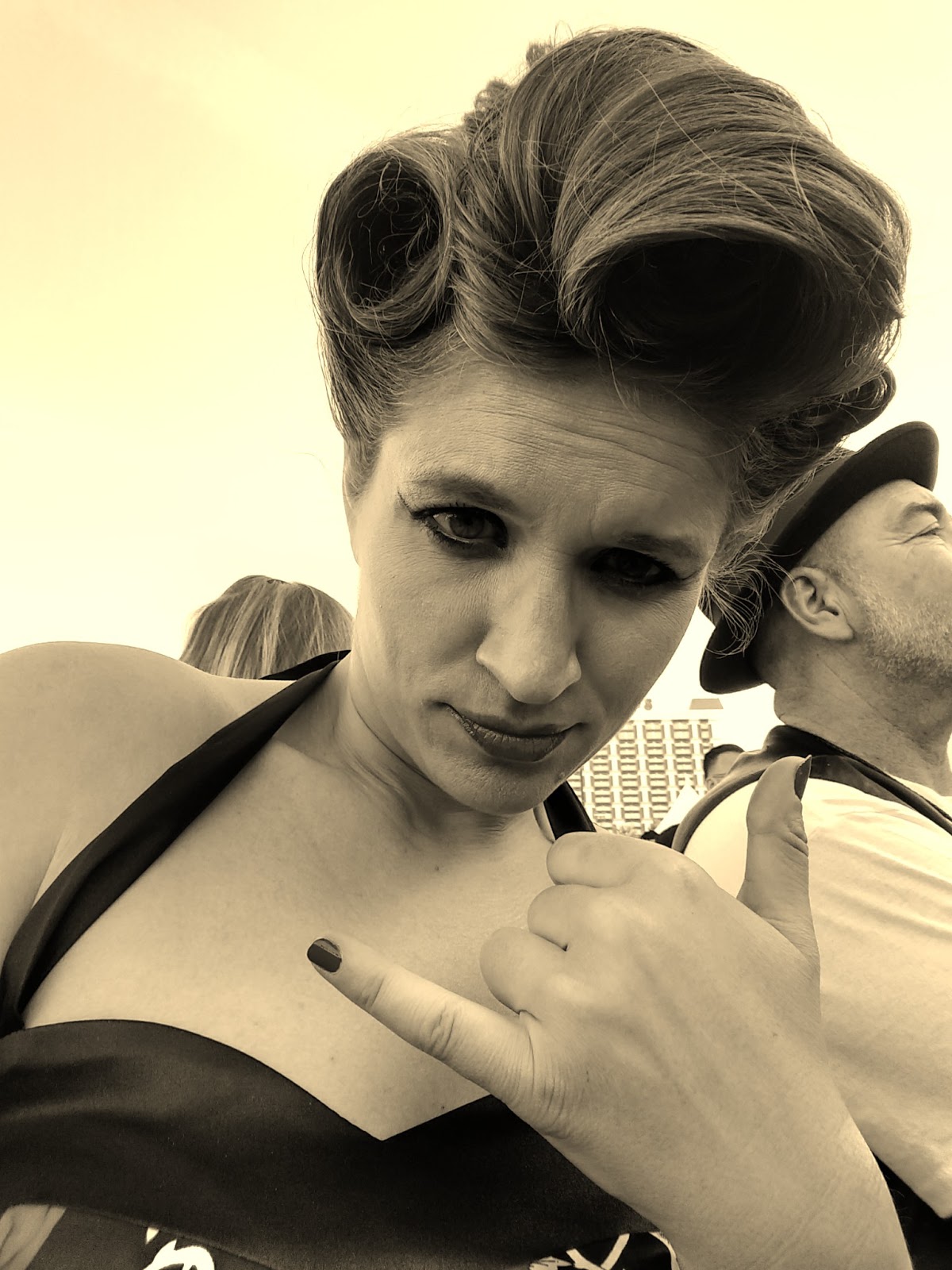
That event was Viva Las Vegas Rockabilly Weekend, the longest running music festival in Vegas, where every cool cat - who loves to brandish a pompadour, or a greased doo, a fedora (or Trilby) [hat] or a porkpie [hat]; a wallet with a big chain and cuffed jeans with a white t-shirt, or big collared dress shirts, sports jackets with textured lapels and cuff-links, or bowling shirts (think Charlie Sheen in 'Two and a Half Men' with pinup ladies or tiki themed imagery); and pointed dress shoes, or saddle shoes, or suede loafers, even stylized cowboy boots - can just chill and hang loose. Viva is where gals who love anything decorated with skulls, little black sparrows, boat ankers, tiki themes, poodles, and don't forget the cherries...or the polka dots. Sweet Baby Jesus, the polka dots; from tight pinup dresses - pencil, wiggle, bell - with slits up to there; and then there's cardigans and big skirts, tight off the shoulder tops, corsets with hot pants, tiny shorts; and petticoats and garters (all manner of structural undergarments) with outrageous high heeled shoes, understated flats, or saddles for her...topping it all off with big hair, all colors, pin-curls, bouffants and victory rolls achieving impressive volume, Betty bangs, ponytails sitting high and proud, all coiffed to perfection with bows, or without, maybe spiked with giant flowers, sheer hair-scarfs (that also work as a neck adornment in a pinch, and also a ponytail adornment), perhaps a snood - and the makeup. Oh the makeup. Don't get us started (yet) on the makeup...all come together in one glorious show of fashion, and style.
It's Rockabilly, meets Psychobilly, meets Greaser, meets Pinup, meets "50s Housewife"...meets anything goes; it's Grease and Crybaby and Rebel Without A Cause, with a splash of Pleasantville, all coming to life under the hot April Vegas sun.
(Want to know more about the styles? Check out Vintage Dancer, What IS Rockabilly? Wiki It Here)

Not hip enough to dress up? Don't wanna be a hep cat? Squares are welcome too.
After all, everybody who has invested hundreds, even thousands, of dollars, not to mention massive amounts of time, need and want an audience.

This year marked the 20th anniversary of the event and It. Was. Massive.
Massive because not only has it has grown in popularity (people literally come from all over the world to attend), but also massive because, according to Tom Ingram, the diligent gentleman who started the event and keeps it thriving, along with a modest office staff, this year there was measurable wristband fraud. This means some group of assholes made counterfeit wristbands and attended events, events that are limited to a set number of attendees to prevent burdensome lines and overwhelming crowds. And the crowds were indeed overwhelming. And the lines, burdensome.

A little about wristbands. Wristbands are what those who purchase High-Roller Tickets wear, at $140 (US) a pop, in order to have unfettered access to all events, which includes, but is not limited to: all music acts - music acts that come from around the globe, first access to vendors - who also come from all corners, the car show, the burlesque shows - this year included much coveted tickets to see Dita Von Teese perform (some people started waiting for the tickets, which didn't become available on the day of access until 9am, as early as 4am), workshops and classes - such as hair and makeup, and dance, and the pool parties and swimsuit contests. You get the picture. High-Roller Tickets are the bees knees. And some utter tits went ahead and tainted the event. It definitely had an impact on us and the gentleman that accompanied us to the event. But it was still one of the best experiences, non-event activities included, in a long time.

Now a direction shift...
You can't talk Vegas without covering some basics.

Accommodations. The event takes place at The Orleans (just off strip). We didn't stay there because the rooms set aside for attendees booked fast and we didn't even plan on going to Viva until mid-September. The week Viva #20 started they opened up room booking for next year's Viva #21. While people were definitely able to snag rooms even the week of the event, it was more of a gamble than some would probably like. We opted for the Tropicana, it was not only retro, staying within the general 50s theme of the weekend, but also not that far away (though definitely not walk-able).

A word about the Tropicana. The weeks leading up to it meant obsessively reading reviews, both because of excitement and being weary of an older hotel in Vegas and wanting to see what people were saying about their stays. Previous Vegas trips had us staying at the MGM (twice) and the Aria, both generally solid quality establishments.
People seemed to be complaining a lot about the Tropicana, but personally it was better than last year at the MGM - we'd take this year's room over last year's MGM room in a dice roll. The room was spacious and looked true to the picture (A King bungalow room with a balcony). The view was great.
Evening view from the balcony of
a Tropicana bungalow room
It was clean and in better condition than one would expect, given that the room isn't in the part of the hotel that they have upgraded.
People just bitch too fucking much.
Look. If you go to Vegas and are shocked and upset that there is no coffee maker or refrigerator in the room, to the level you are going to complain in a review, you are not thinking logically about where you are. A Vegas hotel isn't like other hotels, first of all, they usually try to make themselves as self contained as possible and strive for profits. Of course they aren't going to have these items (unless you get a room at a higher price point) - they want you to use the coffee shop that pays them to be there, and the food courts and restaurants that also pay fees to be in their establishment. They want you down on the floor listening to the slots and the excitement, not hold up in your room drinking your disgusting self-brewed coffee (P.S. They don't clean those machines in hotels very often, if ever. Enjoy your moldy poor quality coffee, you fucking cheapskate) eating leftovers from Denny's. Because, look, if you're concerned about there not being a fridge and a coffee maker in your Vegas hotel room and feel the need to post a negative review because of it...let's be honest, you're probably the kind of person patronizing a fucking [international] chain restaurant like Denny's, on the Vegas Strip.

We digress.

The Tropicana was a solid pick. Yes, the halls smelled of stale cigarettes, but most everything does in Vegas unless it's a few years new or they are pumping perfume through the building (like at the Aria).

The Slut from Eggslut
Food. That being said. The Tropicana does not offer much, compared to other properties, in the way of food. Not that we tried anything, opting for coffee on the go.
We tried Eggslut at the Cosmopolitan. The Slut (a cage-free coddled egg on top of a smooth potato purée, poached in a glass jar, topped with gray salt and chives, served with slices of baguette) was delicious. Smooth, creamy, and full of what you need after a night (or day) of drinking: carbs, protein, and fat.
Croque Madam from Payard
We'll be honest, like with hydration (outside of the obvious alcohol), we failed to eat as much as we should (more about that soon). We did have breakfast another day, at Payard Patisserie & Bistro in Caesars Palace where we enjoyed Croque Madams (smoked ham, rich and creamy Béchamel sauce, Swiss cheese topped with a sunny-side up egg, and oven roasted tomato and mixed green salad) and shared a house smoked salmon plate. All very fresh and tasty.

Then of course there was brunch at Mandalay Bay's Bayside Buffet. Always a solid choice both when considering price and quality.

The Prime Rib Loft at The Orleans was surprisingly good for a restaurant that hadn't made the itinerary, or even showed up in any of the hours of reviews and lists that were poured over prior to the trip (try the Tempura Vegetables).
Also good at The Orleans was Big Al's Oyster Bar where we split a dozen delicious oysters on the half shell with our traveling companion and had an oyster shooter.
If you find yourself at The Orleans during meal time for whatever reason, both of these are worth a try.

The best meal, however, was at Wicked Spoon in the Cosmopolitan. True to fashion we arrived late. At 9:15 pm. A mere 45 minutes before they started pulling the food (more time is optimal when buffeting, don't you think?), so it was an plate-filling and eating bonanza. Not only that, but all parties involved realized that they had not eaten at all that day so as we piled food onto plates, hoofing them back to the table one by one, as the minutes counted down, the server pulled up another table on which we could place our bounty. Ultimately we got a little of everything we desired. Some dishes left us wanting more, and more time. Not a single thing was disappointing.
While the price tag is a little steep, this buffet is definitely worth it for true foodies. Forget the "famed" buffet at the Bellagio, while it is a very good choice for the meat and potatoes crowd, Wicked Spoon is a culinary adventure. And isn't that what you're in Vegas for? Adventure?
So Much Food at the Wicked Spoon
Okay, so now were down to the tips. <insert just the tip joke here>

6.5" Demonia PIXIE-17
Platform Spike Heart
Vegan Leather Heels
Tips. Our tips on Vegas in last year's blog post involved a lot of info about footwear choice. So obviously we didn't follow our own advice and instead, because of all the fabulous new shoes...like this pair of Demonias, got creative with workarounds on how to wear uncomfortable virgin shoes.
While the pair pictured may look like hell. They were not as uncomfortable as the pair of 5" Pleaser SEDUCE-17 Peep Toe Ankle Wrap Sandal (black with red pipping). While sexy when standing and sitting (or, you know, on your back, probably) walking in them is akin to what a dying Savanna animal must look like, and feel like.

So we used a combination of gel inserts, Dr Scholl's Active Series Blister Defense Anti-Friction Stick (wicked product!), not wearing the same pair of heels twice in a row, wishing for a bone-saw, and at one point, for the second time in life, ending up barefoot on hot Vegas pavement.

Would we do it all again, footwear wise? You bet your sweet ass (though a cute pair of slides might make it into the mix for next time). Why? If you do it right you only end up with a few blisters by the end if that, unless you are used to this kind of footwear, and sore feet...and honestly your feet will be sore anyway. Plus, you'll look great (pack a pair of slides in your purse just in case).

Also, we broke our ride-share cherry and used Lyft everywhere possible, which was really a foot saver, and we loved it. The people were interesting and diverse, they were quick and friendly. After taking a cab a time or two, because the data connection in certain parts of The Orleans is complete crap and therefore the app has a difficult time connecting, it was clear that it's not all that much cheaper than the traditional cab - unless you get a promo deal like we did. More convenient? Definitely. Will we use Lyft for future vacations? Absolutely.

FINAL TIP AND THIS ONE IS IMPORTANT.
Always hydrate with water. Pure as fresh as you can get water. You're in the fucking desert.
We failed big time on this.
And eat.
You're not a super hero. You're not a camel. You can get sick and die.

Not only did we fail when it came to hydration and steady nutrition. We failed at taking OTC allergy mediation. How? Here is the equation:

Lack of Sleep + Alcohol + Dehydration + Malnutrition + 4 Claritins in less than 4 hours [apparently you're not supposed to take more than 1 in a 24 hour period and it actually says, when you Google Claritin, to "Avoid [alcohol]. Very serious interactions can occur" They are right] now mix all of that with sensory overload = will completely wreck you mentally.

Like brain melting, in a bad way.
Like an anxiety attack on crack.
Like you're crying uncontrollably, freaking our your (blessing of a) travel companion. And you are uncertain why this is happening.
And if you're dumb (*looks in mirror*), and don't realize that you are experiencing a twisted equation of doom and perhaps a mild overdose of OTC medication...you will be all the more terrified about what is happening.
Yeah. We should have read the package. But we were drunk and just on the cusp of an anxiety episode already (big crowds, too many people, lots of lights, noise, for too long of a time - we don't get out much).
Who wants to be all responsible and logical when dehydrated, starving, tired, drunk and overwhelmed. Pshaw.

OKAY. Enough of recounting that harrowing experience. Onward and upward!

Two final FUN things...maybe three: Fremont Experience, which in the past 10 years has transformed Fremont into...a lesser experience for someone who yearns for the days they could still find a smoke filled casino with old school Vegas slots. They have taken all the seedy out and have replaced it with more of what you're used to seeing on the Strip. Meh.
Still not terrible though, especially if you venture off and are lucky enough to get some photo shots of the old old old hotel properties turned  guerilla art installations that are soon to be no longer for this world. 

Oh Snap at Oak & Ivy
Fly Me To The Moon at Therapy
Bars to Try: 
Oak & Ivy, a craft whiskey and cocktail bar at the Container Park down the street from Fremont Experience
Therapy right off Fremont Experience (have a Fly Me to the Moon)
Park on Fremont, a gastopub across the street from Fremont Experience (their bathrooms/decor are very cool. Try a drink called Pillow Talk)


Cigar and Whiskey at Davidoff
Also worth a stop, back on the Strip, is Davidoff of Geneva for cigars and whiskey on a Vegas patio. If you're into that kind of thing.
Souvenir cup from
Frankie's Tiki Room

And don't forget about Frankie's Tiki Room, a quick Lyft ride from the strip and definitely the most authentic Tiki bar we've been to. Plus we got this wicked souvenir cup (which contained a drink called the Bearded Clam!


Now Back to VLV The Rockabilly Festival!

It was stellar.
There was so much to do and we only scratched the surface. It's clear why people come back year after year.
The music was great, we didn't catch as much as would have been preferred, but we did catch the sets of two of the important ones and got to listen to the sultry voice of Ms. Brenda Lee, and the rockin' stylings of Reverend Horton Heat (there was video, but Blogger is being a douche - needless to say, their performances were magical).

There were a handful of performers we caught a song or two from just by default of milling from room to room on the second floor of The Orleans, yet none of them were among the handful that was put into the itinerary...But there's always next year.

The pool party, while a brief visit, was a fun place to gaze upon the flesh of all assortments of people
while listening to yet more rockabilly music. This year they had a pool party each day, adding to the
big one they have always had on the last day (Sunday)...which the lines were too long for this year. We never did get to brandish our high waist two-piece with the bottoms that had little white skulls on black background, paired with a red bikini top. But there's always next year. 

Photo credit goes to travel companion,
Instagrams @synthesis
Being part of breaking the Guinness World Record for The Most People Jive Dancing on a Dance Floor at Once was an obvious highlight. However, a truly excruciating experience if you didn't eat and find yourself hungry, are a smoker, or have to pee. The first thing we heard as we walked through the door, after registering, and joining the growing crowd, was "If you have to pee you're screwed. Grab a garbage can if you have to"...because once you're in, you're in, as per official World Record Rules. But once the dance starts, and you get your rhythm (and you must, because you cannot stop, you
cannot improvise, it has to be pure jive for 5 straight minutes), it's amazing. And when you can finally stop and it's announced that it's official, you were just one of 520 people to become part of record breaking history, it's exciting.
It even gave pause to a hardcore smoker who had been trapped in that ballroom for hours itching for a smoke (that was not us!🙂)


Unfortunately we didn't get to go to any of the record hops (aka sock hops) and dance more, an activity we were very much looking forward to...But there's always next year.

Photo credit goes to travel companion,
Instagrams @synthesis
Then there's the car show, beautiful restored and maintained cars, shinny colors and chrome with fun hood ornaments and pin-stripping, just radiating under the hot sun. We managed to only see about 1/5th of the cars, if that, whole sections went unexplored (it was hot, shoes needed to be removed, bobby socks needed to found in vendor tents)...But there's always next year.

Do you see a theme yet?


And finally, we splurged and got our hair done up by Vegas' Heads Will Roll Beauty Salon on Saturday. Best money spent on hair ever. Highly recommend these ladies for any event. Will certainly be returning next year, maybe for two appointments...


So, that's the latest trip. And that's Viva Las Vegas Rockabilly Weekend. There are probably some things missing.
We got the clothes and the shoes and the makeup...all ready to try it again next year.
_____________________________________________

Makeup
This is all the way down here and out of the way because it's for a very select audience.
Okay ladies (and some gentlemen) here are some products we found useful in trying to create vintage makeup look, accessible, and at a low price for a starter. Things we never dreamt of purchasing and using, some are going to be incorporated into any day looks.

  • Rimmel London Scandal Eye Gel Eyeliner - good for a thick cat eye, or wing
  • e.l.f. Eyeliner pen (super inexpensive from Target) - good for a thin wing
  • Benefit Cosmetics Roller Lash Super Curling & Lifting Mascara (available in a mini travel size)
  • **Smashbox Photo Finish Foundation Primer - GAME CHANGER. Never used primer before. Love this product. It does unbelievable things.
  • **Ulta Matte Makeup Setting Spray - there are probably better products, but this is a first for this kind of product and it's pretty impressive if you need your makeup to get you through long days.
  • Ulta Contour Kit - also a first. It's pretty cool. And inexpensive if you want to play with contouring. 
If you're looking for clothes, Amazon. So inexpensive. Lots to choose from in everything from a Small to a 2-3XL. Use search words like pinup, rockabilly, and retro. Also there are loads of other retailers at your fingertips with the same words in a Google search, providers of lush dresses in the hundreds of dollars range. Totally worth looking at for the lust factor.
Same goes for shoes, especially for you larger footed ladies...they have a good selection for size 11-12. But also don't ignore merchants online who cater to cross-dressers and the transgender community!
___________________________________

Hopefully some of this has been useful. Feel free to leave comments, questions, suggestions.
If you see spelling or grammar errors please contact us directly on Twitter @JustCallMeFrank or Facebook: Frank E Ly

As always, harassing and rude comments will be removed at the discretion of this writer. So be an adult.

Saturday, April 4, 2015

Reflection on 'Too Big to Know: Rethinking Knowledge...'

There are about five weeks left before graduation. Graduation! With some exciting opportunities waiting for us at the end of the graduation stage, it can't get here fast enough...but for the countless papers yet to be written. With three of the nine papers under the belt [none of which have been graded yet] (not counting a small writing project that doesn't count as a paper) it felt time to post at least one, at least in interest of keeping the blog active and ready for when there is more time to write for personal fun and enjoyment.

The following isn't a paper that poses an argument. It's a reflection paper, much like those from the Truth, Knowledge and Reality Class last Spring semester (See: Critical Reflections on: 'Free Will' by Sam Harris, 'Why Truth Matters' by Michael P. Lynch, 'When Science Meets Religion' by Ian G Barbour, and 'On Being Certain' by Robert A Burton). It is for an independent reading and study course in Communications of which there are six (self-selected) books.You probably won't see all of the resulting papers here because...well...to be honest you can't put the same amount of effort in every paper when you have nearly 10 to write within about an eight week time frame.

Also. This isn't some of our better writing. It kinda feels like we're phoning it in this semester, so to speak. The heart isn't into it and every fiber just wants to get on with the next part of life....whatever that may be (travel, painting, writing, gardening, cooking, new job opportunities!)

Well. Anyway. Here it is. The first paper of the final semester...


The Life of Knowledge
A Reflection on Too Big To Know by David Weinberger

               The room is the smartest person, according to David Weinberger in ‘Too Big to Know: Rethinking Knowledge Now That the Facts Aren’t theFacts, Experts are Everywhere, and the Smartest Person in the Room Is the Room’. Of course, once you being to understand what he means by the room, your whole concept of information, knowledge and expertise are restructured, as it should be in the world of interconnectedness.
The room is the smartest person, so it goes. However, the room is not exactly a room, and the room is made of networks not walls, and the network is made up of people not conduit. The room is made up of people who, in the new structure of knowledge, become individually insignificant. Rather, they gain significance as a whole in the new organization of knowledge: networks, which make up the body of information, or data. The knowledge is in the network of information (people) itself, the culmination of expertise and knowledge (people) that inhabit the room, which is the very structure of the room. It is in this network where information is transformed into what Skip Walter refers to as “actionable” knowledge which is simply information that is used for a purpose and therefore has significance (3).
The smartest room, this network of knowledge, exists on the internet, in social connections. These networks have developed as places of associations between “lots of people who are different from one another [where they are] not only finding expertise but also generating it” (57). This environment has taken the shape of knowledge, previously linear in nature, and transformed it into not just a circular form, but various forms involving symbiotic relationships.

Structure and Process of Knowledge Itself
Previous to Too Big To Know the idea that knowledge has a shape was, personally, a foreign concept. Weinberger manages to describe how the shape of knowledge has evolved from linear structure – such as one direction information like that presented in books – to a multi-directional web of information in which the seeker can discover information and knowledge in any number of ways  as well as add to it (100).
Despite this new structure of knowledge it has a life which is akin to the life of the old linear knowledge in that it has the same old problems and can be “misquoted, degraded, enhanced, incorporated, passed around through a thousand degrees of misunderstanding, and assimilated to the point of invisibility” (110).  Only previously, the editorial nature of knowledge and expertise prior to the Net was that of privilege, whereas now the editorial nature provided by networks is in the hands of the masses. Expertise has multiple voices thanks to the new structure, and that doesn’t always have positive implications (67).
It is in the hands of the masses that expertise on any one topic can have an array of implications. It is that trait where the network gets its diversity, where it “[…] enables a type of expertise just about impossible to actualize before the Internet existed” and gains “value only because that network contains many different types of people” (55).  The variety is not just in the mere connections of countless people through the network, it is the variety of ways in which they think and what they know (56).
The issue in the network is in the sifting of the large mass of knowledge created by it, to moderate it to a point of usefulness. It calls for a new method of filtering which is now done through methods of influence through social networks. Weinberg says this can be disruptive, especially when it comes to authority of knowledge where it is transferred from experts to people we know (10) – theoretically people who have no valid authority. When information and knowledge is shifted from central “authorities” to an array of influences, both in our social networks as well as the expanded networks connected to them, we are bombarded with fragmented information. This fragmented information shapes perceptions and attitudes. This information may be outside the scope of new authoritarian social networks who never the less are granted authority over the information transformed into knowledge. In this way the information is not so much reduced by filtering as it is should be, but it is compounded; this form of filtering “increase[s] information and reveal[s] the whole deep sea” (13). Weinberger says this mass of information “has consequences” (10), and he proceeds with outlining many of the pros and cons of this new “anything goes” nature of information generation and dissemination.

The Cons in the Pros
Perhaps one of the most interesting concepts Weinberger presented as a pro to the network is a new take on diversity, which is the cornerstone of the “smartest room” in question. The proposal is that the concept of diversity is growing away from that of an ethnic or racial structure, to that of a diversity of backgrounds, education levels, economic levels and experiences that flow through all, regardless of religion, gender, sexual orientation or racial identity. This slow-growing concept, particularly in business, is an idea outside of the popular rhetoric of what traditional diversity is and means.
The kind of diversity Weinberg discusses works by creating a range of new perspectives with heuristic implications which in the workplace presents as innovation and creativity. This form of diversity builds on new ways of seeing and doing and battles against the group-think, which leads to mediocrity (77). This new understanding of diversity can be seen as having potentially ill effects if adopted to broadly, such as the reversal of anti-discrimination legislation. However, for the purposed of the network it can be a positive revolutionary force, as well as a carrying negative attributes.
As Weinberger is sure to point out at various steps, the revolutionary nature of networks does not mean they are all universally smart, or even that the network is universally used. As he points out, referencing the work of researchers Eszter Hargittai and Danah Boyd, “social class, age, and subculture affects [s] how we use the [network] and what it means to us (173). To further illustrate the psychological pitfalls of the usefulness of the network (i.e. the internet), Weinberger states that “for those who have no interest in intellectual rigor, or who lack curiosity […] the Net may well be an environment that degrades knowledge” (91). In these ways the diversity of global society does not translate directly to the diversity of “the room”.
When diversity is functioning properly in the network of “the room” knowledge is built vis-à-vis shared expertise. When done on a mass scale, cognition “quickly migrate[s] to these networks of experts” (62). However, though “knowledge has always been social” in much this way, and the theory goes that we are “smarter when together” the fact is that this isn’t always the case with networked knowledge (51). Now that authority of knowledge is in the hands of the masses, Weinberg makes a claim that the lack of a privileged position introduces the worry that “we will be lost in a swirl of contradictory ideas” (90-91). It is difficult not to see how this plays out in everyday dissemination of information on the net. As Weinberger says, in some cases the network is dumber (67) for its mass cognitive blend, creating misrepresentations (66) and having an isolating effect on information (63).
Networks are subject to forming insulation from criticism and outside points of view, resulting in echo chambers (63). According to Weinberger, citing the work of Cass Sunstein, this type of insulated echo chamber can lead to the breeding of extremism (83). In the network, extremism birthed from isolation is counter intuitive to the positive creative nature found in the aforementioned diversity, a nature which promotes a more objective view than those of static ideologies. This problem is at the root of what Cass Sunstein calls “information cascades [where] false and harmful ideas […] gain velocity [and credibility by how easily] and frequently they are forwarded”, passed on, or shared (117). One not need be in the network of the internet long to recognize this outcome is not only real, but persistent.
To further the point in his parlay of cons of the network, Weinberger reflects on the work of techno-dystopian Nicholas Carr, who says that what the internet is doing is changing our cognitive processes for the worst. While on some level this may be an accurate perception for some, it is highly technodeterministic, as Weinberger confers, to conclude that “technology causes us to use and understand it in particular ways” (173). The idea that technology acts upon us, causes as if by force, and not the other way around, has implications regarding ideas of free will and control in relation to the technological world.
Other problems with information and knowledge transference in the network arise in interpretation, which, as Weinberger advises, is always subjective. Knowledge, in all of its structures, lives in the connection of life (119); and while it is accessible to all, sans the network in previous generations, it “shows itself to use depending on our starting point, viewpoint, and inescapably human sense of what matters to us” (180) and “all knowledge and experience is an interpretation” (89).
Interpretation is essential to the transference of knowledge, but in “real events are experienced by individual minds that strive to create an accurate inner representation which is then expressed in words presented to others” (112) and creates a world in which they approach their understanding “from a particular standpoint (113). As Weinberger states, “our experience is always from a point of view, looking at some features and not others” (89), experiences of which there are countless ways in which to interpret everything (90). These experiences must contain context in order to be made sense of (90). Each frame of context carries the standpoints of the past with it which impacts the effectiveness of how we convey information and knowledge, as well as how we interpret it.

Importance and the Culture of Knowledge
Being left to figure out what is important about the evolving structure of knowledge, with its mass contribution of variable information from multiple standpoints, it is not hard to recognize the fatigue that transpires through the overload of the system. Even more are the implications on how to navigate what is available and come to terms with the death of authoritative knowledge. Understanding how to navigate these new structures and processes of knowledge is important, and are subject to a culture of their own which is “guided by implicit rules and expectations” and become important to aspects of social structure (90). The underlying fact is that knowledge is essential to the process of creating identity and culture, to understanding the world and ourselves (4).
With a network of connectedness that inhabits many parts of the globe, bringing together a plethora of ideas, theories, and beliefs, “information overload [arises] as a cultural condition (9).
The information provided isn’t necessarily essential, and the overload feeds the insecurity of our own knowledge and instincts. For example, Weinberger briefly remarks on child raising experts who dispense “skill […] often with just a few cogent mottos” (49). The consumption of books such as these types of boiled down common-sense guides to life illustrates the insecurity of our own knowledge, authentic knowledge passed down generation after generation, basic instinctual knowledge. When we erroneously put into the hands of the masses the authority on basic knowledge, it threatens the authentic self. With any number of experts available we often forget that within us is our own knowledge. For this reason “learning to evaluate knowledge claims” and developing critical-thinking skills becomes more essential than ever before (192). Unfortunately it often seems that critical thinking skills fall by the wayside as those who consume knowledge, dispensed from those who have been afforded authority on the grounds of nothing, neglect their own instinctual knowledge.

So What, Now What
With all of the cons, Weinberger still notes that “a net richer in metadata [information] is richer in more usable and useful knowledge” (188). Despite the range of expertise and useful knowledge created in the diversity of the network, he acknowledges that “we are going to disagree about everything”, attributing it to the very nature of diversity which inhabits the network of information and knowledge (87). The fact that our perceptions, beliefs, ideas and attitudes are individually shaped by so many different voices means each of us approaches the same knowledge set with different ways of viewing it. However, this can be recognized as nothing new; humanity has have never really agreed on anything. If it had agreed on anything, things would have remained the same throughout history. No revolutions, no loss of attributes deemed essential by some and inconsequential by others – no growth or change.
Perhaps the networked world in which we now live in, in which everybody projects their voice into the abyss of knowledge and expertise, has simply been magnified by the network. Perhaps it was always like this, but through this new structure of knowledge, in the amplified connectedness of society, we now see how disconnected we really can be on various subjects such as those of human rights, politics, gender, religion, and any number of other less essential topics. Alas, Weinberger’s “pragmatic truth” sums it up, “what we have in common is not knowledge about which we agree but a shared world about which we will always disagree” (182).

Throughout the book Weinberger probes how media, communication and information shapes and influences culture and the implications the new structure of knowledge has for the future. The topics laid before you were merely highlights and musings as there is neither time nor space to plumb the depths of his text for the purpose of this reflection. The best way to conclude is with Weinberger’s own utopian aspirations of the potential for “the smartest room”, optimistic and hopeful, that “…perhaps our hyperlinked infrastructure will give us a self-understanding that makes it easier for our curiosity and compassion to overcome our self-centered fears.” (193).
xxxxx

Friday, May 16, 2014

Critical Reflections on Why Truth Matters - Part 3 of 3

If you want to know what "this" is all about, or why it is, start with Critical Reflections on True to Life: Why Truth Matters - Part I: Cynical Myths and Critical Reflections on True to Life: Why Truth Matters - Part II: False Theories. The intro to those provide context to this final reflection for the three part series. (spoiler: it was for a University course)

For the regular readers of this, and previous reflections, thank you for reading. Hopefully you have been inspired to think further about truth, knowledge, free will, and reality.

As always, feel free to comment, argue, etc.

Part 3: Why Truth Matters

“If you tell the truth, you don't have to remember anything.” 
― Mark Twain 

As previously stated in class, truth matters because we care about people being honest with us, and all healthy relationships require trust, which requires honesty. As Lynch points out throughout the third section, truth among people in society is important to get things done and to maintain levels of trust (152). Truth is an important ingredient in achieving common goals and sharing information, and lack of truth – lies – are a violation of communication, which is damaging to society. Truth is a central aspect of many parts of life and things would be very bad if everyone lied all the time. Without truth, things would fall apart, both in society and in interpersonal relationships.

If this is not enough to convince the reader they should care about truth, Lynch presents agreeable alternative reasons, aside from simply caring about truth for its own sake. He highlights the intrinsic value of truth to self. Caring about truth in general, Lynch says, is a path towards authenticity, self-awareness, self-regard, and self-respect, and knowing the truth about what you care about is part of intellectual integrity. (35) People who care about the truth, and acknowledge what they care for it, therefore have a good sense of the degrees of self and have increased self-respect, according to Lynch. It would be nice to think most people care about self-respect, however, often times it seems the opposite.

Lynch says that caring about truth and honesty leads to authenticity and integrity, and that “our lives go better when they are lived authentically and with integrity”. (20) Additionally, caring about truth is essential in knowing ourselves and being self-aware. “What we can know – or not know - about ourselves runs the gamut”, says Lynch (121), but we can know and understand ourselves better through truth. Therefore, truth becomes a building block in self-understanding and identity construction.

Further, caring about truth leads to the knowledge of what matters to us and promotes self-reflection; a lack of which he attributes to internal traits such as laziness, lack of discipline, but also external factors such as, poverty, hunger, lack of education, cultural discouragement of reflection (Lynch, 122). Additionally, not caring about truth or what we think leads to self-deception and when “we don’t really care about what we think we care about and we live our lives with bad faith” (Lynch, 122).

People who approach truth with ambivalence experience instability. While Lynch claims that sometimes this is inevitable due to “overpowering and contradictory pressures of outer circumstances” (123), I would like to assume he means ambivalence about specific truths (i.e. religion), and not truth overall, because to not care about any and all truth just seems, to be frank, dumb.

Logically, caring about truth requires “being open-minded and tolerant of others’ opinions, being careful and sensitive to detail, being curious, and paying attention to evidence […] being willing to question assumptions, giving and asking reasons, being impartial, and being intellectually courageous” (Lynch, 129-130). The pursuit of truth also includes the willingness to admit when one is wrong, and is not a matter of consistency, but a matter of the ability to consider information and adjust beliefs accordingly. Not standing up for what you think is right is a lack of intellectual integrity, according to Lynch, but defending a view without bothering to examine it for truth is also a lack of intellectual integrity. In lack of intellectual integrity is the lack of authenticity, which indicates lack of self-control. These are all very agreeable assertions.

An important part of caring about the truth and seeking the truth, in Lynch’s eyes, is sincerity, which has “instrumental value” (153). Lynch says caring about truth, seeking truth, is risky; but caring about truth also leads to authenticity and degrees of happiness, which gives life meaning, because in not caring about truth, one lacks of self-respect, and lack of self-respect leads to unhappiness – again, very logical. As Ellen J. Langer, professor of psychology at Harvard University says, “Self-respect […] may hold the key to achieving the peace of mind we seek”, and by self-respect, she means acceptance. (Langer, 1999) As Lynch has said you cannot accept yourself if you do not know yourself, which happens in-part through caring about the truth. What Langer suggests also coincides with Lynches theory on happiness in caring about and valuing the truth, and living a “life lived well”. Happiness, while it can be allusive, becomes more attainable through truth.

You can hardly talk about truth without talking about lying. Lying involves belief, but in a different way, when “what you say is not what you believe” (Lynch, 147). Lying is just as complex as truth. According to Lynch there are many kinds of lies, from ambiguous to equivocal. According to Lynch there are justifiable lies, which are ones used to “save-face” or protect the feelings of others, or in some cases, such as in the government, used to temporarily protect national security. Some lies a “tall tails” or “yarns”, and some are outright “bullshit lies”. Lies, then, can be just as subjective as truth, but are generally intentional and meant to be misleading or deceiving and other nefarious motivations. Additionally, lies harm people, and lies breed more lies. Not very noble ends, really.

In the end chapter, Lynch dipped his toes into politics and truth, while interesting, and seemed like a personal rant about his issues with liberal democracies. What really stood out is that when discussing “the liberal” he used pronouns such as “herself”, “she” (165). I am also not so sure that I agree with Lynch when he states that “liberalism is presupposed a concept of objective truth” (167). If anything, conservatism seems more inclined to objective truth (based on religious “truth”), while liberalism is more subjective, and that is why conservatives assert that liberals “don’t believe in truth” (evidence of which can be found doing a very quick Google search). In any case, it seems that when Lynch took to the political soapbox and with him a broad brush of personal opinion, certainly detected throughout the claims in other parts of the book, also. This does not make what he says any less “true”, but for people who want to deny truthiness in his truth, it is an opening for contention.

Ultimately when it comes to choosing between the truth and a lie it is important to remember, like with anything, that you should treat others as you would have them treat you. Surely there are few people in the world who want to be lied to. At the end of the day not finding value in truth, at least for the same of it, and rejecting truth as something exists is dangerous, just as is thinking there is no such thing as free will and becoming a victim of self. Giving up on truth embraces doom, for who wants to live in a society where nobody believes in truth.

Lynch never had to convince me to care about truth, because being lied to hurts. However, he did present new ways of thinking about truth, especially in relation to truth being a potential catalyst in becoming a better happier person. Hopefully more people come to see that there is a clear value in truth, both personally and for society.


References

Langer, E. J. (1999, 11 1). Self-esteem vs Self-respect. Retrieved from Psychology Today: http://www.psychologytoday.com/articles/199911/self-esteem-vs-self-respect

Lynch, Michael P. True to Life: Why Truth Matters. Cambridge: MIT, 2005. Print.

Tuesday, May 6, 2014

Critical Reflections on Why Truth Matters - Part 2 of 3

The last (3rd) reflection paper for this book, and the class, is done (and will be posted next week).
WE'RE DONE!
As fun as it was to do all of these reflective papers, on Free Will by Sam Harris, On Being Certain: Believing You Are Right, Even When You're Not by Robert A. Burton, When Science Meets Religion: Enemies, Strangers, or Partners? by Ian G. Barbour, and finally True to Life: Why Truth Matters - it's nice to be done.

Tomorrow is our last day of classes, finals are next week. We're nearly done with all the final writing assignments. The end is here. Finally.

Next week we'll be writing our official blog post for the 2014 American Psychology Association  Mental Health Month Blog Day. It'll be the third year in a row. (2011, 2012), last year we dropped the ball on it. Not sure why.


A friend on Twitter (and a talented Canadian artist), @CanadianCheri/SelfProclaimedMuse - who we've had the honor of meeting has a beautiful entry about learning to love her bipolar life.

And finally...part 2...(Part 1 is Here)...enjoy. Or don't.

[Past essays, papers and other University related content can be found here, the essays and papers are from the last year - the other stuff is personal historical stories: http://just-call-me-frank.blogspot.com/p/university.html]

Part II: False Theories

Coming to a consensus on how truth is formed, and why truth is formed are the only ways to come close to understanding of what truth is. As Lynch says William James posits, truth is made not found (62). In the “real world” people do not put a label on what kind of truth they believe in i.e. pragmatic (classical or modern), reductive naturalist, verificationsim, etc and they don’t often consider why a truth is a truth. But why are truths made? That answer depends on the philosophical line of thinking; self-delusion, power, and/or comfort. For most people it comes down to personal truths, based on beliefs about morals and values, generally meant as a tool to guide decisions and action, rarely thought of as a thing.

In fact, in reading the various views set forth by Lynch in True to Life, truth becomes an ambiguous theory and in other visions, it becomes nonexistent. In some instances, with its lack of properties, truth simply becomes a word describing subjective abstract concepts just as words like good, evil, true, false, do. To some this renders truth unimportant and meaningless – there is no such thing as truth! (Lynch, 106) The truth in a belief can be subjective. There is no realistic or rational truth, commonly known as pragmatic truth – but there is truth and it is complex. As stated in my previous reflection paper, and by Lynch, that by thinking of the complex nature of truth, truth, “much like “courage, kindness, and love” truth becomes recognized as something that has many forms. (100)

According to Lynch, Williams James asserts, “Truth of a belief consists in the practical use it has in your life” and truth “helps us to deal, either practically or intellectually” with reality. (64)

The first idea Lynch presents is that beliefs are a tool. They help people get what they want; truth is a means, not an end. Truth may be utilitarian in that it can get you what you want, and in that, there is value to truth. By the classical pragmatism standards of truth, in the utilitarian properties, truth has cash value because truth is a way of attaining something. However, lies, or false truths, can also get people what they want, sometimes more and better things than truth can provide, such as more opportunities, a better job, or a longer lasting relationship.

If a truth is perhaps equally as utilitarian as a lie, then why does truth matter, why tell the truth at all? There may be many answers, each individual will have a reason why truth matters to them, but in order to understand why, truth must be defined and recognized.

The first “problem” for some is finding the tangibility in truth. As reductive naturalism states, truth does not take physical form or space and therefore there is no reality in truth. (Lynch, 76) Truth has no physical properties, but as Lynch says of the nature of the reductive naturalist’s views, it poses a “serious threat to truth’s value”. (77) In the very least truth can be tangible and verifiable in the sensory experience, i.e. whether or not you can see, touch, smell, hear, and/or feel it. It still does not take truth out of the field of subjectivity though.

The second problem then, to people who philosophize about truth, is that the value of truth is not verifiable or falsifiable by scientific method. Truth is not verifiable by physical properties (Lynch, 89). The idea that things, that are not things, or “non-natural property”, are not true means, to some, they have no value. (Lynch, 89) In the very moral nature of truth, there is a lack of way to verify its worth. However, according to Nietzsche, it is “power that is valuable, not truth” (Lynch, 103). It is not truth itself that is powerful, but the illusion of truth that has power. If illusion is a lie, then false truths (lies) theoretically have equal value as truth. Taking Nietzsche’s concepts, but removing his idea of illusion out of truth, truth, along with lies, attain value. That value then is not money, but power, which becomes a means to money.

Truth still remains ambiguous, particularly those based on ethics and morals, which are manifestations of emotions, feelings and attitudes, simple synapses in the brain, often with cultural bearings. While truth based on morals cannot be justified or verified, truth is still dependent on reality and therefore tangible through consequence. As John Stewart Mill says, the consequence of taking action is what makes beliefs right or wrong (Lynch, 66), in ascribing right or wrong, truth develops a property; while it may not be a physical property, it a property that can be felt (by anyone who is not a sociopath).

In the coherent belief of coherence theory truth is given another property. To counter the “perceptual illusion” (Lynch, 86) of truth, this theory states that to be a truth, the truth must cohere with other beliefs within that belief, no matter what further information is receive. In this, if you believe in x because y, but z presents something that proves y incorrect, than x is no longer a truth. Therefore, truth becomes part of a whole.

While “it is useful to believe that truth is deeply good [it] doesn’t explain why it is deeply good, or even how it can be deeply good” (Lynch, 115). The ways in which truth is good can be seen in the opposite of the truth, which is the lie. Lying requires effort that taxes your brain, costs you money, causes stress, and effects you in many other ways. (Dachis, 2012) According to Jeff Hancock, truth is an important part of being true to yourself. (Hancock, 2012) In this, the real worth, the real good of seeking truth and the value of truth itself, the real reason truth matters, is found in the maintenance of your healthy positive self, the power and the value of being true to yourself.

In reading and reflecting on this section, I have created my own working definition of truth. Truth is a valuable power that is part of a whole of beliefs, guided by goals and values, which has tangible consequences good and bad, and helps in the sustaining of the best you.

References

Dachis, A. (2012, December). What Lying Actually Does to Your Brain and Body Every Day. Retrieved from     Life Hacker: http://lifehacker.com/5968613/what-lying-actually-does-to-your-brain-and-body-every-day

Hancock, J. (2012). The Future of Lying. (J. Hancock, Performer) Winnipeg, Canada.

Lynch, Michael P. True to Life: Why Truth Matters. Cambridge: MIT, 2005. Print.


Tuesday, April 29, 2014

Critical Reflections on Why Truth Matters - Part 1 of 3

This book...is dry. It's not nearly as interesting as the other books for this class. It's the last one.
Honestly? We're running out of steam and it's hard to focus, and it's probably going to be obvious in the three reflections for this book (though next week's one, while shorter, is a lot better).

Truth...

When you put it into the hands of "professional" philosopher...well.
Holy fuck if nearly everything you put into the hands of a philosopher isn't turned to nonsense.

This class, about truth, reality and knowledge, isn't solely a philosophy class. It's a humanities class. It has been a great class. Inspiring, even. But now the professor has hit the philosophy portion. Ten years ago or so when attempting to take an intro to philosophy class, when faced with having to drop a class for personal reasons, it was the first to go. Even then it just seemed...there's really no word for it. Utterly ridiculous? Nonsense? Irrelevant? (hey, there's a whole series of blog entries about the philosophy of philosophy, if we wanted to write them)
So you can imagine the feelings now. Despite desperately wanting to understand and appreciate much of it, it has always been illusive. We could say more. But you get the point. Reading it makes the head spin...and it's so dry...one almost becomes lost, parched in a desert just reading it.

So, what follows are attempts at trying to muddle through concepts in the first section, broken down into headings like:
- Truisms about Truth
- Is the Truth Attainable?
- Is Truth Relative?
- The Truth Hurts
LOADS of concepts and differing opinions based on many, almost endless, fields of philosophy...on the topic of truth.

[Past essays, papers and other University related content can be found here, the essays and papers are from the last year - the other stuff is personal historical stories: http://just-call-me-frank.blogspot.com/p/university.html]

So...
Part I: Cynical Myths

The prospect of approaching the premise of truth, at first, seems very agreeable. Cut and dry, truth is good – all of it. To really break down truth into segments of facts and beliefs, and how they work together while being influenced by bias and perceptions, is to realize that there are many kinds of truths.

In Lynch’s first section, Cynical Myths of truth, he outlines the four “truism of truth” well enough. Starting with objective truth, in that something true is true for all people, whereby truth is something that exists whether or not anybody believes it to be so (11). He makes sure to adequately explains that believing something is true does not make that belief intrinsically true - meaning the world is not always, or necessarily, the way we believe or wish it to be. “Wishful thinking leads to believing falsehoods” (13), according the Lynch, and falsehoods are not truth.

Even mere objects themselves become subject to truth and reality through phenomenalism where objects, seen to be nonexistent without the observer, become suspect of being true. Taking the thought experiment of George Berkeley, ‘if a tree falls in the woods and nobody is near enough to hear it, does it make a noise’ and asking “if nobody is there to see it, does the tree even exist?” never mind make a sound. So many philosophies and so many different kinds of truths: physical, moral, spiritual, knowledge, cultural. Not everything has one truth, while at the same time one truth has to exist for some things, an opinion which, according to Lynch, may be viewed as a cynical myth. In acceptance of the worth and importance of truth Lynch makes sure to present his underlying rejection of negative myths associated with attainment of truth, such as the belief that there is only one truth. He also rejects the ideas that only “pure” reason can access the truth, that truth is a mystery that only some people can know, and that we should pursue the truth at all costs (20). At first the notion that we should not pursue truth at all costs was shocking, but upon further study, it seemed to me that Lynch was equating the attainment of truth with attainment of knowledge, whereby all manner of atrocities have been carried out through unethical practices. Lynch presented examples, one where Nazi scientists who, in trying to attain knowledge of the resilience of the human body in various temperatures of water before freezing to death, used Jewish prisoners from the concentration camps. This was not so much a pursuit of truth, as it was of information. It is true that humans will freeze to death in cold water. How long it takes them at different temperatures is not a truth, because with each person it will vary due to body size, weight, age, physical fortitude – information attained can be viewed as knowledge. In Lynch’s other example I also found it to be a faulty by my own beliefs of the separate natures of truth and knowledge; however, that does not mean my belief on the matter is true. Going further into the section in views towards relativism, I found that there is a case to be made for the subjective nature of some truths, as opposed to objective, but not for relativism itself. Where individual relativism is concerned, the radical reductionism involved seems at once arrogant or egotistical.

Lynch asserts that truth is fundamentally good and that the best most authentic truth is based on good evidence, and further, that beliefs not based on good evidence should be subject to criticism. The pursuit of truth is a worthy goal, and to pursue the truth requires inquiry, the ability to cast off the assertion of correctness while understanding no person can believe on demand, and so must be presented with evidence. Lynch claims that belief is not something that can be controlled, yet it can be indirectly controlled through pursuit. By changing of perceptions, open-mindedness, entertaining curiosity, and an understanding that “absolute certainty is impractically and probably impossible” (29) truth becomes a worthy quest if simply for the properties of self-improvement.

Most people want the ugly truth, according to Lynch, over beautiful illusions, even if the truth has no practical value. However, a similar claim about people not wanting the truth can also be made, particularly of religious peoples; as Friedrich Nietzsche said of faith, faith is people “not wanting to know what the truth is.” Yet many people strive for truth for the sake of truth because they understand to live under an illusion is impractical and to do so offers no value, and in truth, there are realities, while sometimes painful, that are worth the pursuit which leads to practical ends.

The most interesting assertion that Lynch made was that the mere fear or discomfort in being wrong is proof that someone has a preference for truth. However, it could be said that they have a fear of their personal truths being wrong, and are not necessarily concerned with truth itself, but rather the loss of identity structured about what they believe to be true, and not, as Lynch says a concern for their intellectual integrity, but rather reputation. Bottom line, it is right to accept truth, even if it creates uncomfortable realities.

Some truth is unattainable, but not all truth is unattainable, because as previously stated, some truths are subjective, as with much of life, truth is not black and white. However, when beliefs are created through bias and false perceptions, as Kant claimed they are, beliefs that lead to things such as sexism, racism, and stigmas surrounding disabled and mentally ill, persist. People see what fits their paradigm, and are blind by things that threaten it and by prejudices based on habits of thought, employed concepts which are modified by the structures and habits of mind. Conceptual choices based on whim, or constructed around race, gender, etc., determines what we believe but not whether those beliefs are true. (Lynch, 42)

Beliefs are often wrapped in standards of certainty because “we want certainty because we want safety […] if certainty is dead, everything is permitted” (29), if everything is permitted that there is chaos. According to Lynch, evidence and sound reason lead to certainty of truth and in not caring about truth a person is not caring about justifying their beliefs and in so their beliefs do not truly exist. Further “not having true beliefs is bad […] because pursuing truth is good” (29), but it is important to recognize when a belief is false, because having false beliefs is equally as bad as having no beliefs at all. As the commonly used phrase attributed to so many people says, “If you don’t believe [or stand] for something, you’ll fall for anything”, but that is not to say that what you stand for or believe in should not meet standards of truth. Anything presented at truth should be subject to skepticism. Important lesson in skepticism: “The most dangerous man is he who is certain, absolutely sure, that his way is the right way” (29) causing him/her to feel justified in not listening to questions or considering alternate views. The frightening awareness is that we may never be able to be absolutely certain of anything, but that doesn't mean we should stop striving to be as close to the truth as possible.

As stated earlier, I do not buy the idea of pure relativism, that “truth is in the eye of the beholder” (31) and in so personal truth is the only truth and all other truth is inaccurate, which essentially creates a personal illusion that one can never make mistakes or be wrong. Further, people who back up their relativist views with the assertion that “everybody is entitled to their own opinions”, as Lynch says, simply prevents “reasoned discussions” and is a stumbling block to the attainment of truth. Surely, everybody is entitled to their own opinion, but that does not make their opinion factual or true.

Lynch’s own objective truth that “stealing is wrong and also illegal” is the key to how I see the subjective nature in some truths, and this is probably where I use the term subjective because I reject the narcissistic quality that lies in pure relativism. For example, there is a subjective nature to right and wrong, and truth and untruth. If a parent for whatever reason has fallen on hard times and has a hungry or starving child, unable to attain resources through public services, steals some bread to feed the child, then stealing, while it remains illegal, is not wrong. Similarly, companies swindling money from customers is wrong though often not illegal by business practices. While surely there are many examples of how truth can be subjective, this appears to be a worthy illustration.

When considering whether or not politics hold sway over what we think is true, Lynch asserts that political power and systems of power produce and sustain it truth. (37) However, as an alternative view, Gandhi said to the sustaining of truth through power, “An error does not become truth by reason of multiplied propagation, nor does truth become error because nobody sees it. Truth stands, even if there be no public support. It is self-sustained.” [1] When truth takes a turn at being a political and cultural issue (40), Lynch’s “acceptable truths” in the community at the time are not so much truth as they are views and beliefs that cause people to believe something is true, and as Lynch says, are rooted in power structures which change over time.

Finally, truth hurts, but it is a good hurt.

However, Lynch made a very interesting case for why some self-deception, such as in unrealistic “positive thinking”, can be a good thing. Perhaps in this he presents the only case in which I would view untruth to be beneficial. According to Lynch, some self-deception can lead to positive self-fulfilling prophecy – for example thinking too highly of your skills or abilities so that you actively perform up to those standards. It was also interesting that he noted, that in studies, people who were depressed had a more realistic view of themselves as opposed to these practicing in self-deception (48). Pursuit of truth are cognitively and morally good (49), because truth about ones’ own psychological aspects construct the reality of personal identity (53-54), but thinking more highly of yourself, lying to yourself, somehow is beneficial…if you can believe yourself.

Belief about truth are at the base of who people are, whether or not they realize it. It might be a generalization, but I do not think most people think about truth very often. By this I mean, people are quick to point out lies, or untruths, but rarely do they inspect for the truth in the untruth. To look at all things presented in life with a bit of skepticism, whether it be towards acclaimed truths, or bald-faced lies, and to inspect them with curiosity is imaginative. In skepticism, there can be curiosity, in curiosity there is the creative. In all of this, there is the pursuit of truth. As Picasso once said, “Art is the lie that enables us to realize the truth.”

Skepticism → Curiosity → Creativity →Truth

“I must continue to bear testimony to truth even if I am forsaken by all.” 
– Mahatma Gandhi


Source:
Lynch, Michael P. True to Life: Why Truth Matters. Cambridge: MIT, 2005. Print.
Citation:
[1] Mahatma Gandhi, Young India 1924-1926 (1927), p. 1285